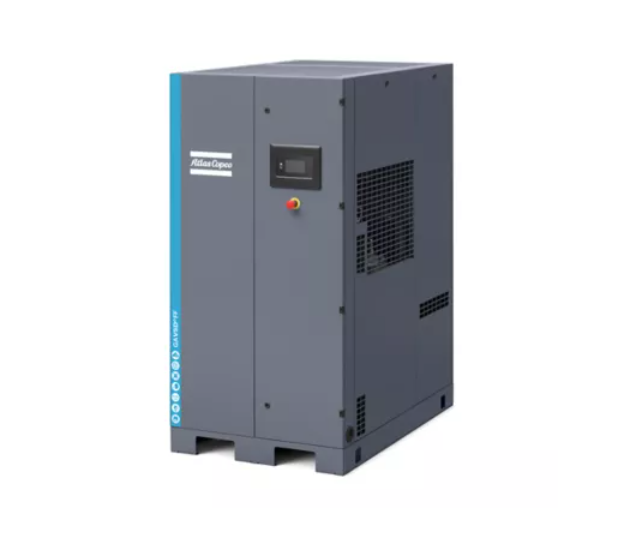
Atlas Copco GA5 - GA37VSD Oil-Flooded Screw Air Compressors

Atlas Copco GA5 - GA37VSD Oil-Flooded Screw Air Compressors

Atlas Copco GA5 - GA37VSD Oil-Flooded Screw Air Compressors

When you need the best, choose VSDˢ - Variable Speed Drive compressor. 
The GA 5-37 VSDˢ offers significant 
energy savings up to 60% compared to fixed-speed models, making it a highly efficient compressor that stands out in the market. It also raises the bar in performance, reliability and connectivity to support your sustainability and productivity goals – now and in the future.
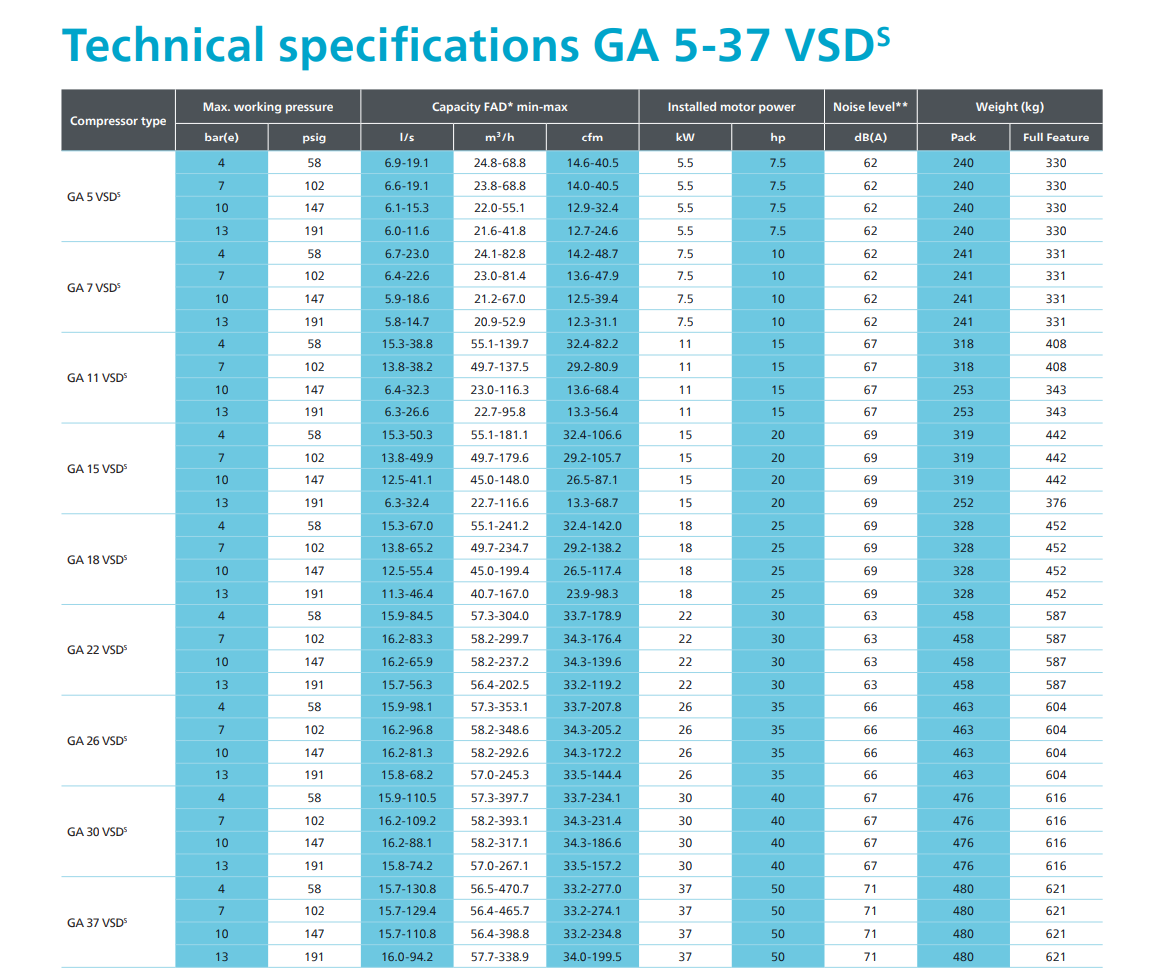
Atlas Copco GA5 - GA37VSD Oil-Flooded Screw Air Compressors

•   The technology that drives sustainability 
-  FASR motor The VSDS Ferrite-Assisted Synchronous Reluctance motor is a compressor exclusive: IE5 efficiency and
built without rare earth materials.
-  Neos Next The inverter that is crucial in generating up to 60% energy savings and a significantly smaller environmental footprint.
-  Energy recovery Developed in-house, the VSDS Energy recovery system gives you additional energy savings by recovering and re-using up to 80% of the heat the compressor produces.

•   GA 5-37 VSDS The compressor for a new generation 
-  Atlas Copco’s first-generation Variable Speed Drive compressors gave you up to 35% energy savings. Our VSD+ achieved 50%. Now, the GA VSDS raises the bar once again with energy savings of up to 60%. This is the new GA 5-37 VSDS , developed and built for a generation that wants it all. 

•   Sustainability
-  Double-digit reductions in energy use lower
your emissions considerably.
-  Limited use of rare earth materials.

Savings
-  Reduced energy consumption by up to 60% (compared to our GA fixed-speed models).
-   Additional energy savings with up to 80% heat recovery.
-  Advanced connectivity features maximize efficiency.

•   Strong performance
-  20% Free Air Delivery (FAD) increase on average compared to our GA fixed-speed units.
-  FASR motor equals IE5 standards.
-  Inverter and motor exceed IES2 (EN 50598) requirements, matching the highest ratings.

•   Smart features
-  Smart Temperature Control System ensures optimal oil temperature and injection.
-  Boost Flow Mode allows you to temporarily exceed maximum compressor capacity.
-  Intelligent drains limit energy use and service intervals.

•   Superior connectivity
-  Advanced Elektronikon® Touch controller.
-  SMARTLINK real-time, remote monitoring and optimization.
-  EQ2i multiple compressor control.
-  OPC UA available for production system integration.

•   Small & silent
-  Sound levels as low as 62 dB allow for placement on your production floor.
-  Extremely small footprint ensures easy, flexible installation.
-  An innovative side-mounted 200l vessel provides air storage while keeping the compressor's footprint very compact
(GA 5-11 VSDS).

•   VSDS The compressor re-invented
New drive train
-  Designed according to IP66.
-  New high-efficiency element.
-  Ferrite-Assisted Synchronous Reluctance motor equals IE5 standards.
-  Oil-cooled for maximum efficiency.
-  No gears or belts means no transmission losses.
Neos Next inverter
-  Combines the functionality of an entire electrical cubicle in one compact unit.
-  IP54-protected from dust and dirt.
• Inverter and FASR motor exceed IES2 (EN 50598) requirements for power drive efficiency
VSD fan
-  Variable speed.
-  Low vibrations and noise.
-  Reduced cooling needs.
-  Meets ERP2020. 
Smart Thermostatic Control Valve
-  Maintenance-free.
-  Routes the oil via the coolers to achieve the ideal injection temperature.
Intelligent no-loss drain
-  Ensures the automatic removal of condensate to minimize loss of compressed air.
-  Tracks drain cycles and maintenance schedule.
-  Detects potential issues and transmits warnings to controller
Elektronikon Touch controller
-   High-tech controller with warning indications, compressor shutdown and
maintenance scheduling.
-  Easy to use and designed to perform in the toughest conditions.
-  Standard SMARTLINK remote monitoring to maximize air system performance and energy savings. 

•   A new generation of savings and sustainability 
-  VSDS is the third generation of Atlas Copco’s VSD technology. It continues a proud tradition of ground-breaking energy savings with up to 60% lower energy use compared to GA fixed-speed models. But the VSDS is more than the most energy-efficient compressor on the market today. It is a comprehensive re-invention of VSD technology that allows for true production sustainability. 
-  Energy matters The true cost of owning a compressor both financially and in terms of sustainability – lies in its energy use.
After all, energy takes up 80% of the lifetime cost of a compressor. That makes efficiency the number one requirement to reduce your operational costs and environmental footprint in a meaningful way.Fixed-speed: unadaptable energy use 
-  Traditional fixed-speed compressors only have one speed, 100% on. The result is a lot of wasted energy when your demand is lower.

•   VSD: energy use follows fluctuating demand
-  Atlas Copco Variable Speed Drive compressors have an inverter that allows them to adjust their motor speed to match the air demand to give you unprecedented energy savings:
-  Elektronikon Touch controls the high-efficiency Neos Next inverter and the motor speed to lower energy use.
-  No wasted idling time or blow-off losses during operation.
-  Compressor can start/stop under system pressure without the need to unload.
-  Eliminates peak current penalty during start-up.
-  Minimizes system leakage due to a lower system pressure.
-  EMC compliance to directives (2004/108/EG).

•   Quality Assurance
-  The Seller warrants that the ordered goods are manufactured from high-quality materials and standard processes, are brand new and unused, and fully comply with the quality, specifications, and performance stipulated in this Contract. The Seller further warrants that the goods ordered under this Contract, when properly installed, used, and maintained, shall be free from defects for a period of 18 months from the date of shipment from the port of export, or 12 months from the date of commissioning, whichever occurs first.